

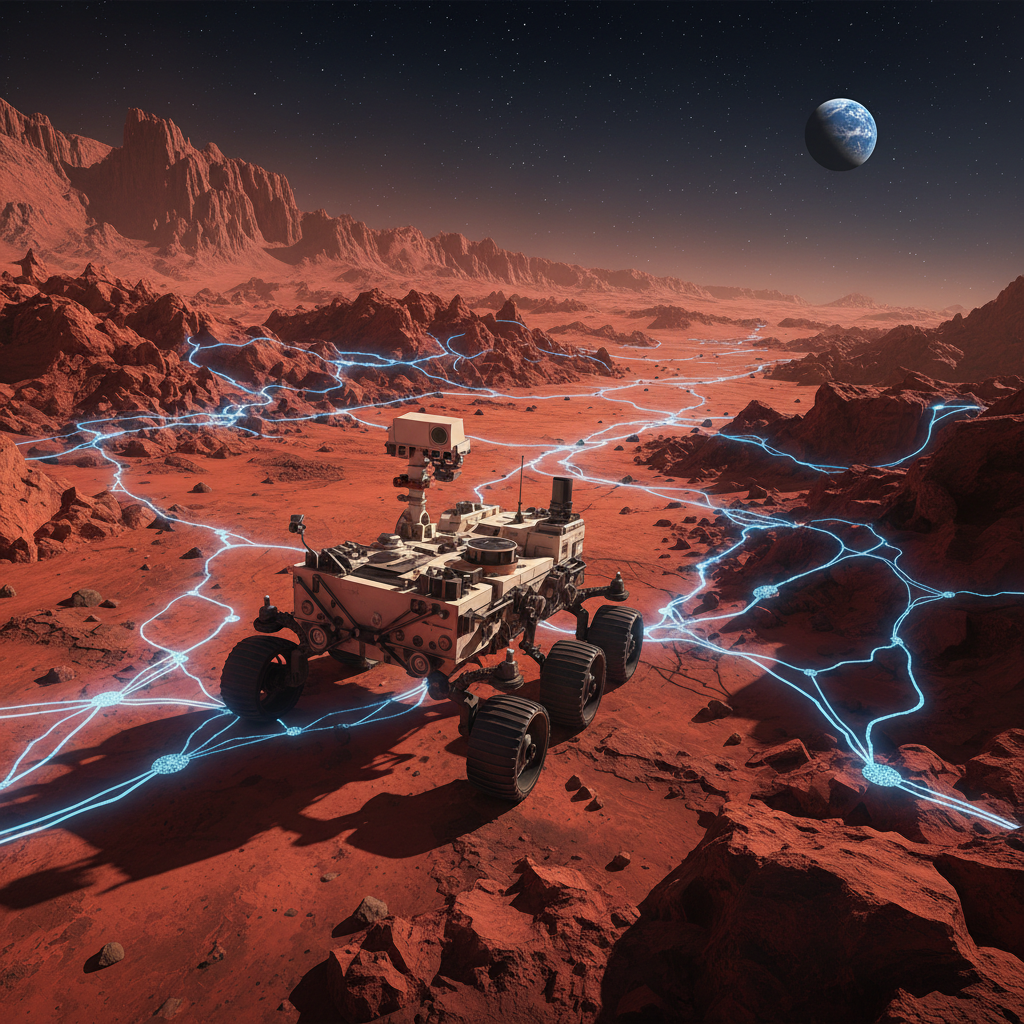
The First AI-Planned Drive on Another Planet
On December 8 and 10, 2025, the commands sent to NASA's Perseverance rover had been written by an AI for the first time. Anthropic's Claude planned the drive.
Engineers at NASA's Jet Propulsion Laboratory (JPL) used Claude to plot out the route for Perseverance to navigate a 400-meter path through a rock field on the Martian surface. Four hundred meters is one lap of a running track, but it marks a historic start for AI in space exploration.
The Challenge of Driving on Mars
Exploring Mars means always operating in the past. It takes about twenty minutes for a signal to reach the rover from Earth. By the time a new instruction arrives, the rover has already acted on the previous one.
Every rover drive needs to be carefully planned to avoid the machine sliding, tipping, spinning its wheels, or getting beached. Human operators have traditionally laid out waypoints using images taken from space and the rover's onboard cameras. The plan is then transmitted across 362 million kilometers via the Deep Space Network.
This is high-stakes work. In 2009, the Spirit rover drove into a sand trap and never moved again.
How Claude Planned the Mars Rover Route
JPL's engineers tested whether Claude could help plan Perseverance's route with the same accuracy as a human operator. The process was set up in Claude Code, which provided the agentic coding environment for the task:
| Step | Description |
|---|---|
| Context loading | Years of rover driving data and experience provided to Claude Code |
| Image analysis | Claude's vision capabilities analyzed overhead orbital images |
| Route planning | Waypoints plotted in 10-meter segments along the path |
| Code generation | Commands written in Rover Markup Language (XML-based) |
| Self-critique | Claude iterated on its own work, suggesting revisions |
| Validation | Over 500,000 variables modeled in simulation to verify safety |
| Human review | JPL engineers reviewed and made only minor adjustments |
JPL engineers gathered years of driving data and experience, then loaded it into Claude Code. With this context, Claude wrote navigation commands in Rover Markup Language, the XML-based language originally developed for the Mars Exploration Rover mission.
Validation and Results
When JPL engineers reviewed Claude's plans, they found that only minor changes were needed. For instance, ground-level camera images gave a clearer view of sand ripples that Claude hadn't seen, requiring a more precise route split in one narrow corridor. Otherwise, the route held up well.
The plans were sent to Mars, and the rover successfully traversed the planned path. Engineers estimate that using Claude will cut route-planning time in half.
What AI Mars Navigation Means for the Future
Claude's role in the Perseverance mission is a test run for what comes next. The key capabilities, understanding novel situations, writing code for complex instruments, and making decisions without constant human input, apply directly to longer and more ambitious missions.
Upcoming AI Space Applications
- Artemis Campaign: NASA plans to send humans back to the Moon and establish a base on the lunar south pole
- Lunar Operations: AI could assist with mapping geology and monitoring life-support systems
- Deep Space Probes: Autonomous AI could help explore distant parts of the solar system where signal delays stretch to hours
- Ocean Worlds: Future probes might visit moons like Europa or Titan, descending through icy shells to chart courses through subsurface oceans
The same AI model that developers use to write code and scan for vulnerabilities is now helping humanity explore other worlds.
Original source
https://www.anthropic.com/marsFrequently Asked Questions
What did Claude AI do on Mars?
How does Claude plan a Mars rover drive?
Was the AI-planned Mars rover route safe?
How much time does AI route planning save for Mars rovers?
Stay Updated
Get the latest AI news delivered to your inbox.