


Agentic AI Revolutionizes Marketing: From Hours to Minutes
In the fast-paced world of digital marketing, agility and efficiency are paramount. Yet, many marketing teams find themselves bogged down by time-consuming manual workflows—hours spent on page assembly, endless coordination emails, and iterative review cycles. These operational bottlenecks divert valuable resources from core strategic work: understanding customer needs, developing impactful messaging, and designing campaigns that truly resonate.
However, a new paradigm is emerging. The AWS Marketing Technology, AI, and Analytics (TAA) team, in collaboration with Gradial, has pioneered an agentic AI solution built on Amazon Bedrock. This innovative system dramatically accelerates content publishing workflows, slashing webpage assembly time from an arduous four hours to a mere ten minutes—a staggering reduction of over 95%. This transformation empowers marketing teams to publish content with unprecedented speed and consistency, allowing them to redirect their focus towards strategic customer engagement and innovation.
Unpacking the Bottlenecks: Traditional Content Publishing Challenges
For Digital Marketing Managers (DMMs) and Product Marketing Managers (PMMs), publishing a single webpage is often a complex, multi-stage ordeal. The journey typically begins with a campaign brief, progresses through kick-off meetings, enters a prioritization backlog, and involves extensive back-and-forth communication before any actual work commences. This traditional workflow is plagued by several critical friction points:
- Prolonged Page Assembly: The creation of a webpage involves meticulous configuration of components, structuring layouts, and integrating content within predefined Content Management System (CMS) frameworks. This demands specialized knowledge of CMS workflows and available component sets, leading to hours of manual labor.
- Cross-Team Coordination Delays: After initial assembly, content undergoes multiple review cycles—copy, creative, links, backend validation, and stakeholder sign-off. Any issues discovered at this stage necessitate revisions, triggering additional review loops that significantly extend timelines.
- Technical Dependencies: When requirements exceed existing CMS components, marketing teams must engage engineering for custom updates. This introduces external dependencies and can stretch project timelines considerably.
- Reactive Quality Control: Essential checks for content health, accessibility compliance, brand standards, and SEO are typically performed at the very end of the process. Discovering issues post-assembly leads to costly rewrites, increased coordination, and potential delays of days, rather than hours.
The AWS TAA team recognized these weren't isolated problems but symptoms of a fundamental workflow inefficiency: too much time dedicated to mechanical assembly, and insufficient time for strategic, business-driving activities. The solution, therefore, needed to address page assembly comprehensively, as this is where coordination, dependencies, and validation requirements coalesce.
The Agentic AI Solution: A New Era for Marketers
The new agentic AI solution introduces three transformative capabilities designed to streamline the marketing workflow: natural language page assembly, real-time content validation, and end-to-end workflow execution within a single session. Gradial's integration with the AWS Model Context Protocol (MCP) is key to establishing real-time connections with enterprise content systems.
Natural Language Page Assembly through Amazon Bedrock
Marketers can now simply describe their content needs and desired page actions using natural language. The system, powered by Amazon Bedrock models—including Anthropic Claude and Amazon Nova—interprets these requests to identify necessary components, determine optimal layout structures, and generate the required configurations. This automation of component selection and configuration, facilitated by structured instructions passed to Gradial Agents, simplifies layout decisions that previously demanded specialized CMS expertise. The result is faster page assembly without the need for deep technical knowledge.
Real-time Content Quality Validation via an MCP Server
A significant leap forward is the shift from reactive to proactive quality control. The Model Context Protocol (MCP), an open protocol designed for AI systems to connect with external tools and data sources, plays a crucial role here. An MCP server links the Agentic AI solution directly to content quality systems. This enables real-time validation of content against SEO, accessibility, and brand standards during the assembly process.
As depicted in Figure 1 below, Gradial leverages AWS health services to ensure content adheres to proprietary compliance and quality guidelines. This allows authors to identify and rectify issues immediately within the same session, circumventing the delays and complexities of scheduled review meetings days later.
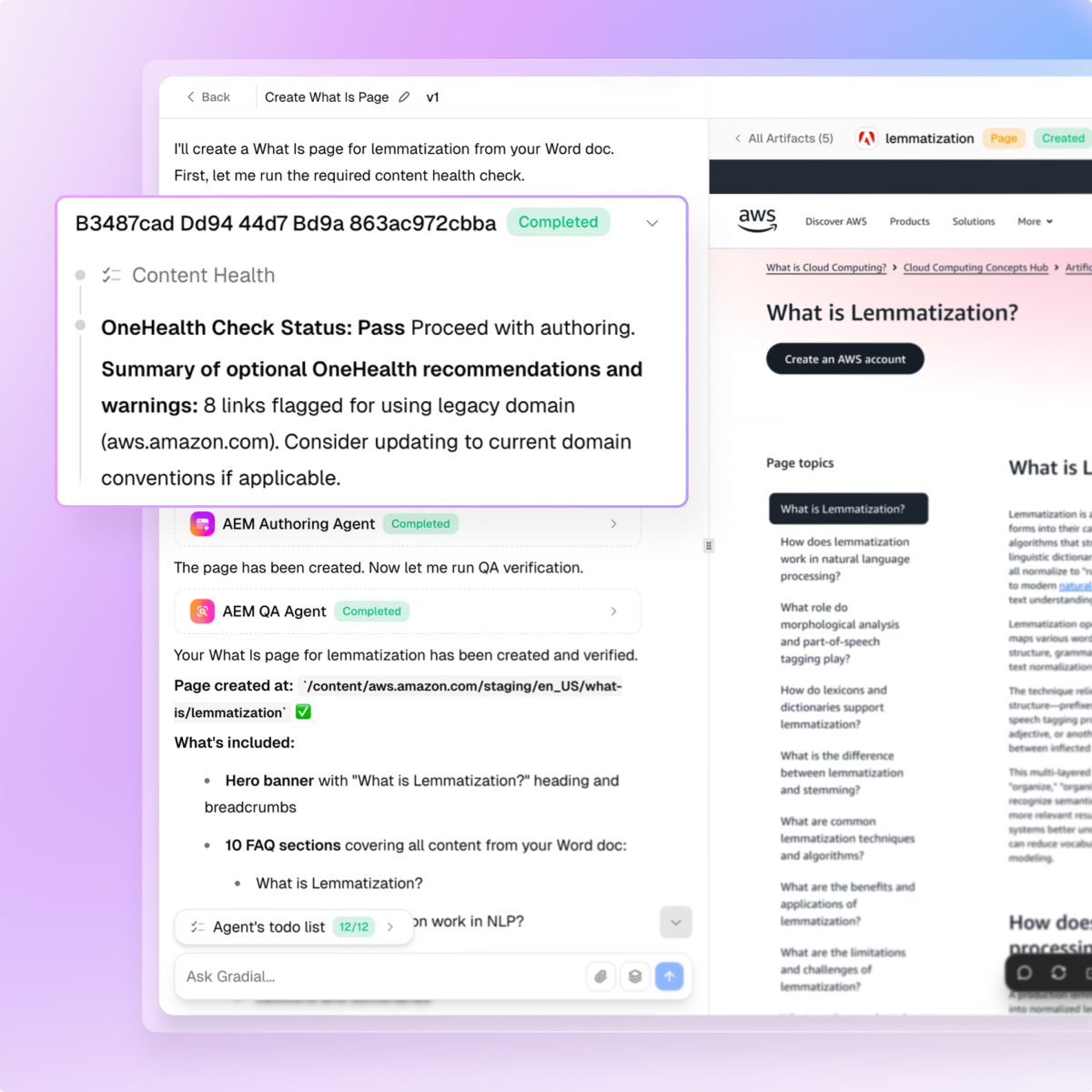 Fig. 1: Gradial invokes AWS health services to validate content against proprietary compliance and quality guidelines, SEO, accessibility, and brand standards. This real-time validation makes sure issues are identified and corrected early in the process, allowing users to address problems before proceeding with page assembly.
Direct CMS Execution through a Proxy Layer
A dedicated proxy layer establishes a programmatic link between Gradial and the CMS. This connection enables the creation and configuration of assembled pages directly within the content model and existing publishing workflows. Gradial transmits structured instructions via this proxy, allowing the CMS to handle page creation, component rendering, and publishing governance as usual. This crucial layer maintains the CMS's authority as the primary publishing system while drastically reducing the need for manual authorization before content goes live.
Architectural Deep Dive: Powering Agentic Marketing Workflows
The elegance of this solution lies in its intelligent orchestration of advanced AI models and robust integration capabilities. At its core, AWS Bedrock serves as the foundational platform, offering access to leading foundation models. Anthropic Claude, known for its strong reasoning and conversational abilities, and Amazon Nova, are instrumental in interpreting complex natural language inputs from marketers. These models translate high-level requests into actionable, structured commands.
Gradial’s agentic framework then takes these commands and orchestrates the entire workflow. It’s responsible for intelligently selecting the right components, structuring layouts, and managing the creation process within the CMS. The Model Context Protocol (MCP) is critical here, acting as the connective tissue that allows Gradial to communicate with various enterprise tools—from content health services to the CMS itself—in real time. The proxy layer ensures that all interactions with the CMS are compliant and secure, adhering to established governance frameworks. This sophisticated architecture ensures that the agentic system not only automates tasks but also maintains quality, compliance, and seamless integration with existing enterprise infrastructure. For more insights into implementing such systems, refer to our article on operationalizing agentic AI part 1 a stakeholders guide.
Impact and The Future of Marketing Productivity
The results of this Agentic AI implementation are compelling. The reduction in webpage assembly time by over 95% is a testament to its effectiveness. This profound efficiency gain allows marketing professionals to pivot from time-consuming, mechanical tasks to higher-value strategic work. Instead of grappling with CMS configuration and rework, DMMs and PMMs can now dedicate their expertise to identifying customer pain points, crafting more persuasive messages, and designing truly engaging campaigns.
This solution not only accelerates content delivery but also improves content quality and consistency across digital properties. By embedding real-time validation into the creation process, it proactively addresses issues that previously led to significant delays and costs. The shift from reactive firefighting to proactive quality assurance enhances brand integrity and user experience.
The success of this Agentic AI solution signals a new horizon for marketing operations. It demonstrates how intelligent automation can transform bottlenecks into competitive advantages, enabling marketing teams to be more agile, strategic, and impactful. The ability to reclaim hours from repetitive tasks empowers marketers to genuinely focus on what matters most: driving meaningful customer engagement and business growth.
| Feature | Traditional Workflow | Agentic AI Workflow (Gradial + AWS Bedrock) |
|---|---|---|
| Page Assembly Time | Up to 4 hours | Approximately 10 minutes (95%+ reduction) |
| Coordination & Reviews | Sequential, back-and-forth emails, re-work cycles | Integrated, real-time validation, reduced cycles |
| Technical Expertise | Required for CMS configuration & component selection | Natural language interface, automated component selection |
| Quality Control | Reactive, post-assembly, costly revisions | Proactive, real-time validation during assembly |
| Marketing Focus | Mechanical assembly, administrative tasks | Strategic planning, customer engagement, innovation |
This table vividly illustrates the transformative impact of Agentic AI on key aspects of the content publishing workflow, highlighting the substantial gains in efficiency, quality, and strategic focus for marketing teams.
Original source
https://aws.amazon.com/blogs/machine-learning/from-hours-to-minutes-how-agentic-ai-gave-marketers-time-back-for-what-matters/Frequently Asked Questions
What is Agentic AI in the context of marketing automation?
How does Agentic AI dramatically improve content publishing workflows?
Which AWS services are utilized in the Agentic AI solution for marketing?
What role does Gradial play in this Agentic AI content publishing solution?
What were the main challenges traditional marketing teams faced in content publishing before Agentic AI?
How does the Model Context Protocol (MCP) enhance content quality during assembly?
What measurable results did AWS Marketing achieve by implementing this Agentic AI solution?
Stay Updated
Get the latest AI news delivered to your inbox.