

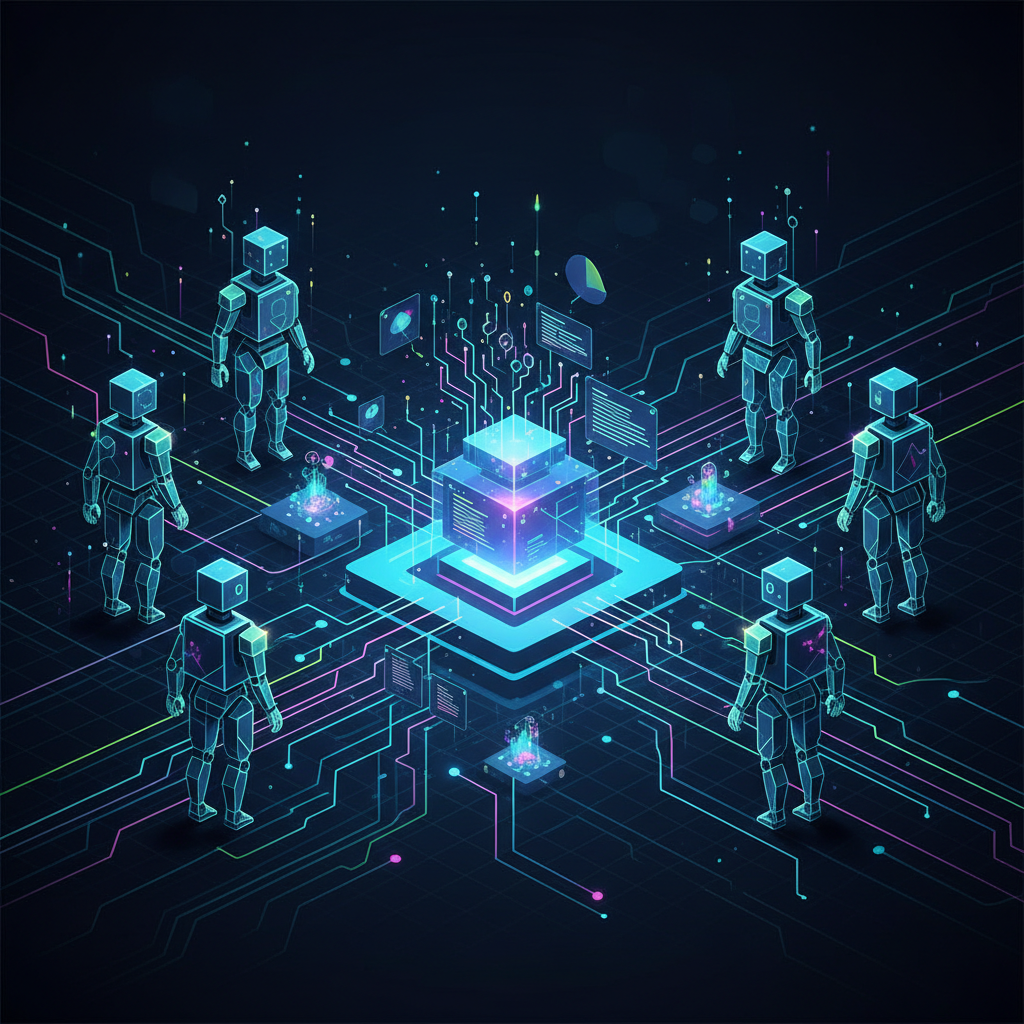
Squad AI Agents: Revolutionizing Repository-Native AI Development
The landscape of AI-assisted coding is rapidly evolving. For many developers, the current paradigm often involves a painstaking dance of prompting, refining, and steering AI models to coax out desirable output. This iterative process, while helpful, can become a bottleneck as projects scale, shifting the challenge from "how do I prompt?" to "how do I coordinate design, implementation, testing, and review without losing context?" Enter Squad, an innovative open-source project built on GitHub Copilot, poised to transform this dynamic by bringing coordinated multi-agent AI systems directly into your software repository.
Squad represents a significant leap forward, betting on the accessibility, legibility, and utility of multi-agent development without the traditional overhead of complex orchestration layers or deep prompt engineering expertise. By embedding a specialized AI team within the repository itself, Squad changes the game for how developers interact with AI, moving beyond single-chatbot interactions to a truly collaborative, agentic workflow.
The Evolution of AI Coding: From Prompts to Coordinated Agents
Traditional AI coding tools, while powerful, often treat the AI as a singular entity. Developers become responsible for both instructing the model and meticulously refining its output. This approach is effective for isolated tasks but falters when faced with the complexity of a complete software development lifecycle. The friction arises from the constant need for context switching, manual quality assurance, and the effort required to align the AI with broader project goals.
Squad, by contrast, establishes a preconfigured AI team within your project, comprising roles like a lead, frontend developer, backend developer, and tester. This team doesn't just respond to prompts; it understands the project's context, history, and even internal naming conventions. This approach frees developers from the incessant need to steer the model, allowing them to focus on higher-level architectural decisions and creative problem-solving.
Traditional AI vs. Squad's Multi-Agent Approach
| Feature | Traditional AI Coding Assistant | Squad's Multi-Agent System |
|---|---|---|
| Interaction Model | Single chatbot, iterative prompting | Coordinated team, natural language directives |
| Context Management | Manual re-prompting, limited session memory | Repository-native shared memory, context replication |
| Task Execution | Sequential, single-agent focus | Parallel execution by specialized agents |
| Quality Assurance | Developer manually tests and refines | AI tester agent provides internal review and iteration |
| Project Integration | Limited, often requires manual copy/paste | Deeply integrated into repository, versioned output |
| Developer Role | "Steerer" of AI output | "Orchestrator" and final reviewer of AI team |
How Squad Enables Coordinated AI Development
The magic of Squad begins with a remarkably simple setup: two commands (npm install -g @bradygaster/squad-cli and squad init) transform your repository into a hub for multi-agent activity. Once initialized, you communicate with your AI team using natural language, much like you would with a human team.
Imagine typing: "Team, I need JWT auth—refresh tokens, bcrypt, the works." Instead of a single AI attempting to generate all the code, Squad's coordinator agent intelligently routes the task. The backend specialist begins implementing the authentication logic, while the tester simultaneously starts writing a comprehensive suite of accompanying tests. A documentation specialist might even initiate a pull request for updated API docs. This parallel processing significantly accelerates development cycles.
Crucially, these specialists are not working in a vacuum. They inherit knowledge of your project's naming conventions and past architectural decisions, not from verbose prompts, but from shared team decisions and their own project history files committed directly to the repository. This deep integration allows the agents to produce highly contextual and consistent code from the outset.
The Independent Review Protocol
One of Squad's most powerful features is its internal iteration and review mechanism. When the backend specialist drafts an implementation, the tester runs their suite of tests against it. If tests fail, the tester rejects the code. What sets Squad apart is its "reviewer protocol," which prevents the original authoring agent from revising its own work. Instead, a different agent is tasked with fixing the rejected code. This forced independent review, with a separate context window and a fresh perspective, ensures higher quality and prevents an AI from repeating its own mistakes. This process, akin to a robust pull request workflow, allows developers to review a refined output that has already passed through an internal quality gate. For more insights into such agentic systems, consider exploring resources on GitHub Agentic Workflows and their underlying security.
Architectural Innovations for Repository-Native Orchestration
Squad's effectiveness stems from several core architectural patterns that move away from opaque "black box" AI behavior towards inspectable and predictable operations at the repository level. These patterns are foundational for building reliable multi-agent systems.
1. The "Drop-box" Pattern for Shared Memory
Unlike many AI orchestration systems that rely on fragile real-time chat or complex vector database lookups for state synchronization, Squad employs a robust "drop-box" pattern. Every significant architectural choice, library selection, or naming convention is appended as a structured block to a versioned decisions.md file within the repository.
This plain-text approach makes knowledge sharing asynchronous, persistent, and highly legible. The decisions.md file serves as the team's collective brain, providing a perfect audit trail of every decision. Because this memory lives directly in the project files, the AI team can seamlessly recover context after disconnects or restarts, picking up exactly where it left off.
2. Context Replication Over Context Splitting
One of the most persistent challenges in AI development is the context window limit. When a single agent attempts to manage all aspects of a task, its "working memory" can quickly become overloaded with meta-management and irrelevant information, leading to hallucinations or incomplete outputs.
Squad elegantly sidesteps this by ensuring the coordinator agent remains a lean router, not a doer. It doesn't perform the heavy lifting; it spawns specialized agents for specific tasks. Each specialist operates as a separate inference call, equipped with its own dedicated and large context window (e.g., up to 200K tokens on supported models). This means you're not splitting one context among multiple agents; you're replicating the relevant repository context across them. This parallel processing allows each agent to "see" and focus on the pertinent parts of the repository without competing for mental space with the internal thoughts or processes of other agents.
3. Explicit Memory in the Prompt vs. Implicit Memory in the Weights
Squad champions the idea that an AI team's memory should be both legible and versioned. Developers should never have to guess what an agent "knows" about their project. In Squad, an agent's identity is constructed primarily from two repository files: a charter (defining its role and responsibilities) and a history (documenting its past actions and interactions). These, alongside the shared decisions.md file, are all plain text.
By storing these crucial memory components in the .squad/ folder within your repository, the AI's memory is versioned right alongside your code. When a developer clones the repository, they're not just getting the source code; they're getting an already "onboarded" AI team whose collective memory and understanding of the project are intrinsically linked to the codebase itself. This approach simplifies onboarding and ensures consistent behavior across different development environments. For further reading on evaluation of such complex systems, consider the guide on evaluating AI agents for production.
Lowering the Barrier to Agentic Workflows
The most significant achievement of Squad is its ability to make agentic development accessible to a broader audience. The project actively reduces the friction typically associated with multi-agent systems, eliminating the need for developers to spend hours wrestling with complex infrastructure setup, mastering intricate prompt engineering techniques, or navigating convoluted CLI interactions. Squad streamlines the process, allowing developers to quickly leverage the power of an AI team to accelerate their coding workflows.
By offering a low-touch, low-ceremony entry point, Squad empowers developers to experiment with and integrate multi-agent capabilities directly into their projects. It encourages a shift in mindset, viewing AI not just as a code completion tool, but as a coordinated, intelligent collaborator. To experience this repository-native orchestration firsthand, explore the Squad repository on GitHub and see how this innovative approach can evolve your development workflow.
Original source
https://github.blog/ai-and-ml/github-copilot/how-squad-runs-coordinated-ai-agents-inside-your-repository/Frequently Asked Questions
What is Squad and how does it revolutionize AI-assisted software development?
How does Squad ensure shared knowledge and consistent context across its diverse AI agents?
What is the 'reviewer protocol' in Squad, and how does it facilitate genuine independent code review?
How does Squad overcome the limitations of AI model context windows for complex projects?
Is Squad an autopilot system, or does it require human oversight and collaboration?
How can developers get started with Squad and leverage its multi-agent capabilities?
Stay Updated
Get the latest AI news delivered to your inbox.